mirror of
https://github.com/20kaushik02/CSE545_SS_Work.git
synced 2025-12-06 08:04:06 +00:00

7.8 KiB
7.8 KiB
CSE 545 - Fall '24 pwn.college Dojo
Project 01 Linux Lifter
.05 - find
find / randomly_placed_file- way too many files- read the man page.
find -name randomly_placed_filefound it - didn't specify a folder to search in tho, ig it's cuz cwd is /
.06 - find and exec
- "Optional Exercise: Why do they think it worked with
-execparameter of thefindcommand, but we get permission denied using standalonecatcommand? Hint: SUID bit was set for thefindcommand." - indeed, we see that
/usr/bin/findhas its setuid bit set: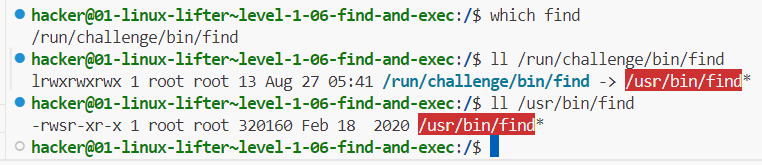
- see here for find stuff
find / -name random_cant_flag -exec cat {} ';'worked
.07 - return code
$?is the return code of the last executed command- range 0 to 255
.08 - python
- SUID on python this time
.11 - search me
/challenge/tester.shis printing/flagbut the file is missing/challenge/cphas SUID bit set- preliminary find revealed a possible file deep in
/tmp find /tmp/that/full/path -name flag -exec /challenge/cp {} /flag ';'
.12 - hash it out
- used online tool to generate SHA256
.13 - hash full
- here we go
- a-z, 6 spaces, so 26^6 possibilities
- plaintext is 6 letters, so 48 bits. hash is SHA256 so 256 bits.
- storage per line:
<hash><plaintext>that's 304 bits, 312 if including newline character - total storage exceeds 11GB!!
- refinement 1: 256-bit hash is pretty unique. if we cut down on the portion of the hash stored, we should be able to save a ton of space while only slightly increasing the margin of error. let's assume plaintext has to be stored entirely for now, so total per line is 184 bits.
- eh fk it, just generated all permutations. 22GB storage, 20 min to generate, search using VSCode search took a few more minutes
Project 02 Unwinding Binaries (Reversing)
.01 - looking inside
- not sure how to use ghidra, didn't seem to work either
angr decompile /challenge/runrevealed astrcmpwith the key, ez
.02 - the mangler
- 'mangling' is just subtracting 3 from the char's ascii value. so just add 3 to the key
.03 - xor plus
- mangling is adding 3 then xor with 2. so just xor with 2, then subtract 3
lab 2a.02
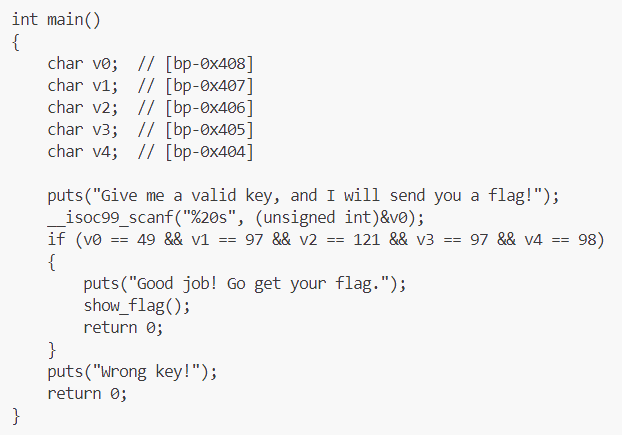
- ascii values
.04 - solve for x
- NOTE: angr screwed up, and gave an incorrect result (== instead of !=)
- use ghidra (GUI) or dogbolt for binaries under 2MB
- anyway, math solving:
- we get a few eqns:
- v1 = v0 - 24223
- v3 = 5v2 - 129519
- use these eqns to reduce from brute-force 4 nested loops to 2 nested loops
- then verifying the rest gets us one soln
- we get a few eqns:
- runtime < 3 seconds
.05 - extra verification
- angr just straight up hangs lol
- holy sh*t so many if statements
- boils down to byte by byte, check 1 or 0, check +ve or -ve (MSB)
- 00 - 00110111
- 01 - 01000111
- 02 - 01000011
- 03 - 01010110
- 04 - 00110100
- 05 - 01010010
- 06 - 01011010
- 07 - 01001001
- 08 - 01000001
- 09 - 00110100
- 10 - 01011001
- 11 - 00111000
- 12 - 01111001
- 13 - 00110011
- 14 - 01110011
- 15 - 01001000
- 16 - 00110101
- 17 - 00111000
- 18 - 01101010
- 19 - 01010111 (binary ninja and hex-rays disagreed on this, binary ninja was right)
- could have automated this smh
.06 - extra verification II
- first ordered all if statements to get bitwise order of the string (hell.)
- for result to be 0 at the end, just don't modify it at all
- so for each if statement, check which of 0/1 makes it false (find and replace ftw)
- ascii string is 67kW6YnKvTpaqoBX1F8l
- really should have automated this
.07 - binary labyrinth
- omg it's literally labyrinth navigation, using wasd keys LMFAO
int M[12][12]={
  { 1, 0, 1, 1, 1, 1, 1, 1, 1, 1, 1, 1},
  { 1, 0, 1, 0, 0, 1, 0, 1, 0, 0, 0, 0},
  { 1, 0, 0, 0, 1, 1, 0, 1, 0, 1, 0, 1},
  { 1, 0, 1, 0, 1, 1, 0, 1, 0, 0, 0, 1},
  { 1, 0, 0, 0, 1, 0, 0, 1, 0, 0, 1, 1},
  { 1, 1, 0, 1, 1, 0, 0, 0, 0, 0, 1, 1},
  { 1, 1, 0, 1, 1, 0, 1, 1, 1, 0, 0, 1},
  { 1, 1, 0, 0, 0, 1, 1, 0, 0, 0, 1, 1},
  { 1, 1, 0, 1, 0, 1, 0, 0, 1, 1, 1, 1},
  { 1, 1, 0, 1, 0, 1, 1, 0, 1, 1, 1, 1},
  { 1, 1, 0, 1, 0, 0, 0, 0, 1, 1, 1, 1},
  { 1, 1, 1, 1, 1, 1, 1, 1, 1, 1, 1, 1}
};
- 1s are landmines
- start from row 1, column 2 (x=1, y=0)
- goal is row 2, column 12 (x=0xb, y=1)
- ssssdsssddsssdddwwwddwwwwdwwd
- lol
Project 03 Hacking Network Highways
.01 - netcat
nc 10.0.0.3 31337
.02 - netcat listener
nc -l 31337
.03 - nmap and netcat
nmap 10.0.0.0-255 # found in .142
nc 10.0.0.142 31337
.04 - nmap in parallel and netcat
-snfor ARP ping scan - no ports just discover host--min-parallelism 10for at least 10 probes at a time- consider using
-T4or-T5timing templates - checked
10.0.0.0/19- only us at .210.0.32.0/19- nothing10.0.64.0/19- 10.0.90.244 and port is 31337 as expected. stopped here
.05 - tcpdump
tcpdump -A 'tcp port 31337'-Ato print content as ASCII
.06 - tcpdump and flow
- inspecting the /challenge/run python script, we see that it's sending one character at a time, after encoding them
tcpdump -s 65535 -nntA 'tcp port 31337' -w /home/hacker/my_pcaps/3.06.pcap-sto grab full packet (?)-nnto avoid resolution of hostnames or port numbers-tto exclude timestamp-Ato print content as parsable ASCII. important!!!
- then we use scapy to read the packets, skip alternating duplicates, decode, and form a single string
- ehh i messed up something but whatever
.07 - mimic and listen
ip addr add 10.0.0.2 dev eth0assign the address to us, fakenc -l 10.0.0.2 31337
.08 - ether scapy
- jfc
- ALWAYS be explicit and define the src addresses
- didn't define the src MAC addr, so packets kept going thru
loinstead ofeth0 - too stupid to realize it in time too
- anyway, get current MAC addr of
eth0 - craft Ether packet to given dest addr with type
0xFFFF srp(pkt, iface='eth0')
lab 3a was chill, no notes
.09 - IP scapy
- similar
- set IP addr with
ifconfig eth0 10.0.0.2 - add l3 with src and dest IP addr,
proto=0xFF - since we need MAC as well, use
srp, notsr
.10 - TCP scapy
- similar
- again, set IP addr
- add l4 with src and dest TCP port,
flags=0x1Fto set ACK (0x10), PSH (0x08), RST (0x04), SYN (0x02), FIN (0x01) flags srpagain
.11 - TCP handshake
- send SYN with specified seq and ack numbers - 31337 both
- get SYNACK
- has ack of 31338, which will be our next syn
- has random syn, add 1 to get next ack
- send ACK with next syn and ack numbers
.12 - ARP scapy
- meh, arp opcode is 2
.13 - ARP spoofing
- meh, just crafting ARP and tcpdump
lab 3b was chill, no notes
.14 - MiTM ARPing
- shit's getting too easy, let's not look at /challenge/run
- first, get target's macs, then arp spoof
- we don't have NET_ADMIN, so can't set ip_forward in sysctl to control MITM directly,
- first, capture packets, check raw loads
- we observe that a sequence repeats:
- 10.0.0.3:31337 sends a command: "SECRET", to 10.0.0.4 at a random port
- note: how does 3 know which port to send to?
- 4 responds with a secret, it's in ascii?
- 3 sends a list of available (?) commands - echo, flag, and then asks for a command
- 4 responds with echo, and sends "Hello, World!"
- 3 echoes it back
- 10.0.0.3:31337 sends a command: "SECRET", to 10.0.0.4 at a random port
- connection closes, repeats with another randomized port for 4
- note that 3 sends a secret and a list of commands that includes a flag command
- craft a packet masquerading as 4, with the flag command, wait for a secret to arrive and put it in the packet
- in the time it takes 3 to do the legitimate echo from 4, we could probably send the flag command to 3 and have it processed in the same ephemeral connection
- let's try